The AI Learning Trap: When Offloading Becomes Cognitive Surrender
A look at how AI is quietly reshaping learning—and why the difference between offloading and surrender matters.
The Pull Toward Passivity
AI feels like a shortcut. Ask a question, get an answer. Summarize a paper, draft an email, fix code. The friction disappears.
But shortcuts can become traps.
Across campuses and workplaces, people are not just using AI as a tool. They are deferring to it. They accept its outputs without checking. They adopt its judgments as their own. Researchers call this cognitive surrender.
The Offloading Continuum: Tool → Crutch → Surrender
Cognitive surrender is a slide, not a switch.
1. Tool (Offloading). AI is used for a small task—a calculation, a search, a first draft. The person keeps their own judgment. The output is a starting point, not a conclusion.
2. Crutch (Dependency). AI is used before trying the task alone. The output is no longer checked against personal reasoning. AI becomes the default, not the assistant.
3. Surrender. Critical evaluation is given up. The AI's fluent, confident outputs are treated as correct. The person no longer checks if the answer is right.
Each step feels harmless. The tool was useful. The crutch was convenient. The surrender happened before anyone noticed.
| Cognitive Offloading | Cognitive Surrender | |
|---|---|---|
| What it is | Using a tool with a plan | Giving up judgment to AI |
| Example | Calculator, GPS | Accepting wrong AI answers without question |
| Awareness | A clear choice | Often unnoticed |
| Effect | Keeps judgment strong | Weakens critical thinking |
Where "Cognitive Surrender" Came From
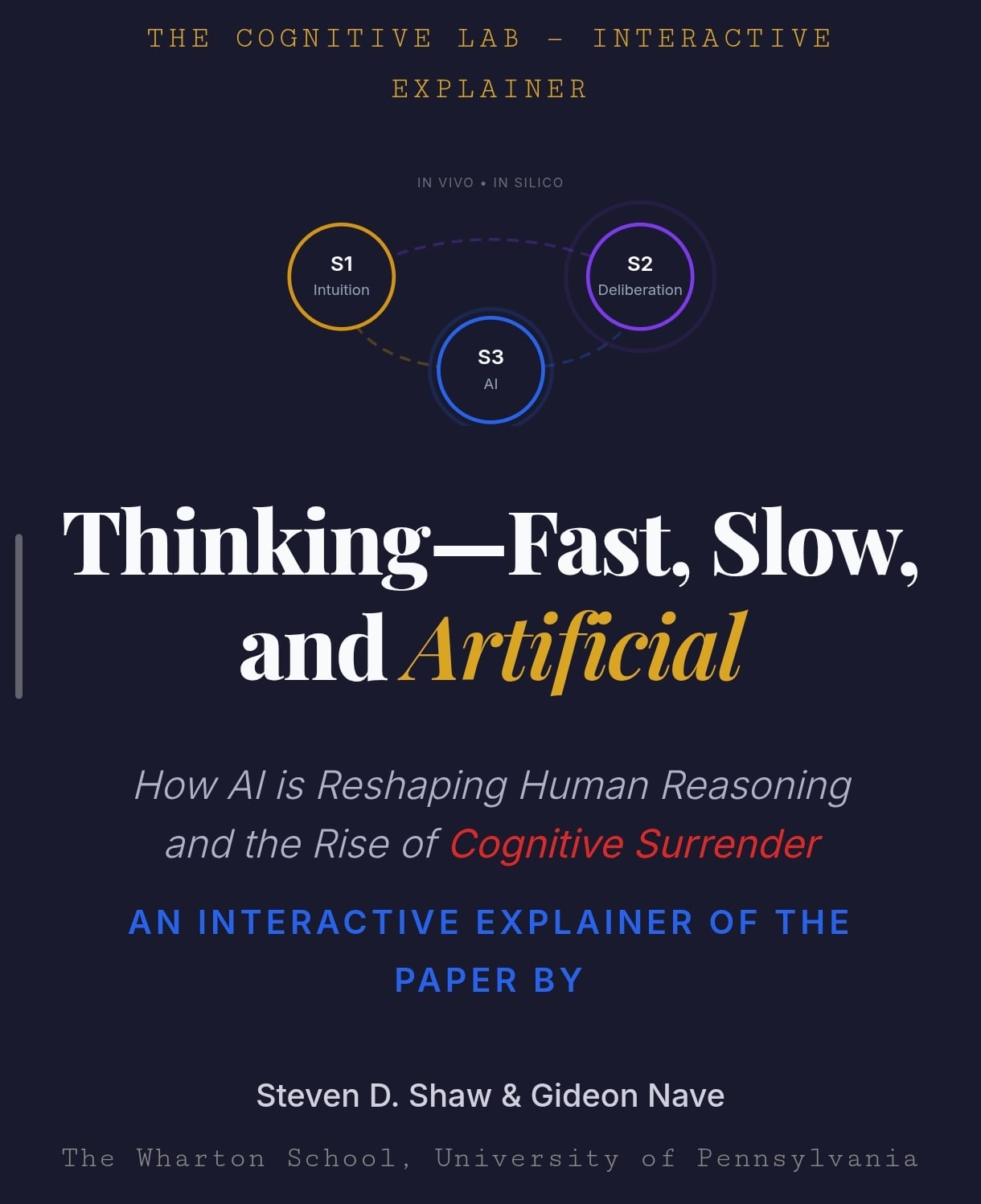
In January 2026, Wharton researchers Steven Shaw and Gideon Nave published a paper called "Thinking, Fast, Slow, and Artificial." They tested 1,372 people on 9,593 reasoning tasks. People accepted correct AI answers 93% of the time—expected. But they accepted incorrect AI answers 80% of the time. Their confidence was 11.7% higher than those who worked without AI.
Shaw and Nave proposed a Tri-System Theory: System 1 (intuition), System 2 (deliberation), and System 3 (AI-assisted thinking). The risk is that System 3 weakens the other two through disuse. As they put it: "There is a shift in the locus of control, with an external system occupying the default position."
What Surrender Looks Like in Practice
- Copying and pasting without reading. The answer is fluent, so it must be correct.
- No longer checking if the answer is right.
- Reaching for AI before trying the task alone.
- Being unable to explain how the answer was reached.
- Feeling anxious without AI.
These behaviors are easy to miss.
The Three Losses
The Learning Loss
MIT (August 2026) warned that AI overreliance "creates an illusion of learning." It disrupts problem-solving and peer collaboration. A Wharton field experiment found students with AI access completed 48% more practice problems—but scored 17% worse on later exams when AI was removed.
Carnegie Mellon tested 1,222 people and found AI assistance reduced persistence and harmed performance without AI—after only 10 minutes of use. "Persistence is foundational to skill acquisition," the researchers concluded.
Oregon State University found heavy AI users had a 66% drop in reflection, a 41% drop in critical thinking, and a 21% drop in the perceived need to understand concepts. Tech-savvy students were more affected.
MIT Media Lab's EEG study found ChatGPT users showed lower cognitive engagement and reduced neural connectivity. The authors warned of "cognitive debt"—a slow weakening of memory formation and independent thinking.
The Judgment Loss
A Nature study of 698 Chinese undergraduates found a negative pathway: higher perceived AI intelligence led to greater immersion, then increased dependency, then lower critical thinking.
Lucy Gill-Simmen of Royal Holloway calls it "epistemic atrophy" —the weakening of thinking habits. "In education, the struggle is often where learning happens. AI removes much of that struggle."
The Reality Loss
Deepfakes are the sharpest edge of surrender. They turn watching a video into involuntary surrender. For decades, video was the arbiter of truth. That assumption is dissolving. Deepfakes trigger quick trust responses before slower reasoning can intervene.
The Sharpest Edge: Deepfakes
In 2024, an Arup employee in Hong Kong joined a video call filled with cloned avatars of the company's CFO and senior board members. He sent 15 payments totaling $25.6 million. He even asked for the video call to verify—the exact step people are trained to take. The deepfake bypassed it.
Legal scholars Chesney and Citron named the follow-on effect the liar's dividend: when deepfakes are believable, anyone caught in real damaging footage can claim it is fake. The technology does not need to fool audiences. It only needs to make denial sound reasonable.
An MIT Media Lab study found that even with clear disclosure, exposure to AI-generated videos increased doubt about later authentic videos and reduced judgment confidence. Damage is done simply by knowing deepfakes exist.
HSE University research found people trust authoritative speakers in deepfakes even when statements contradict the speaker's prior position and the listener's own attitudes.
When people cannot trust their own eyes, who maintains their internal model of reality? Increasingly, no one.
Sources and Their Core Concerns
| Source | Core Concern |
|---|---|
| Shaw & Nave (Wharton, 2026) | 80% acceptance of wrong AI answers; Tri-System Theory |
| MIT Ad Hoc Committee (2026) | "Illusion of learning"; disrupted collaboration |
| Carnegie Mellon (1,222) | Reduced persistence; impaired performance without AI |
| Gill-Simmen (Royal Holloway) | "Epistemic atrophy"; AI removes productive struggle |
| Nature study (698) | AI dependency lowers critical thinking |
| Oregon State University | 66% drop in reflection; 41% drop in critical thinking |
| MIT Media Lab | Doubt about authentic videos; reduced judgment confidence |
| HSE University | Authoritative deepfakes bypass critical thinking |
What This Means
For learners: Use AI as a tool, not a substitute for thinking. Embrace productive struggle. Practice checking what is real.
For educators: Redesign assessment toward oral exams, in-class work, and projects. Set clear AI policies. Teach awareness of deepfakes.
For builders: Design AI to support thinking, not replace it. Build in steps that encourage reflection.
Design the Friction Back In
Frictionless paths win by default. But friction is where learning lives.
- Pause before accepting. Check if the answer is right. See if it can be explained without AI.
- Design friction. Add a step that forces reflection.
- Stay in the room. Personal judgment is the point.
AI solves the work. But the work may be the learning.
Deepfakes show how fast surrender can happen—in milliseconds. Cognitive surrender is not a future risk. It is present reality.
The question is not whether AI will change learning. It already has. The question is whether it will be used to extend thinking—or to avoid it.